
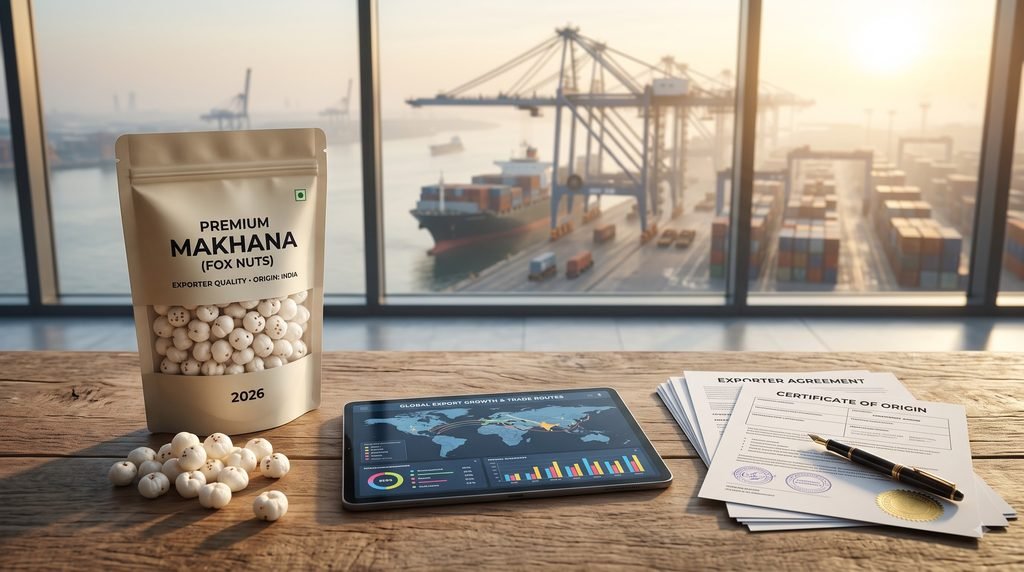
Makhana Suppliers in India: How to Choose a Reliable Exporter (2026 Guide)
Looking for reliable makhana suppliers in India? Superfoods Agency helps businesses explore Indian fox nuts for wholesale, distribution, retail and international sourcing. Whether you are an importer building a healthy-snack portfolio, a wholesaler looking for a dependable bulk fox nuts supplier, or a retailer exploring phool makhana, choosing the right sourcing partner is an important step towards protecting your product quality, margins and customer relationships.
India is an important source of makhana, also known as fox nuts or phool makhana. However, not every supplier offers the same grades, specifications, packaging options or level of export support. A product that looks attractive in a photograph may not meet your expectations when the shipment arrives.
So, how do you identify a reliable makhana exporter in India? What should you check before placing a bulk order? And which questions should you ask to avoid unnecessary costs?
This guide explains the practical steps international buyers can take to compare suppliers, assess product quality, understand pricing and prepare for a successful sourcing partnership.
1. Why Are International Buyers Sourcing Makhana from India?
Makhana is becoming an interesting product for businesses looking to expand their healthy-snack and traditional-food categories. It can be sold as a plain snack, used as an ingredient in food products or developed into a flavoured snack range.
For importers and wholesalers, Indian makhana offers an opportunity to explore a product with multiple commercial applications.
What makes makhana attractive for wholesalers and importers?
A versatile product category: Makhana can be positioned as a plain roasted snack, a flavoured snack or an ingredient for different food preparations. This gives retailers and distributors room to test different product formats.
Different size and grade options: Makhana is available in different sizes and grades. Buyers can compare available specifications to determine which product is appropriate for their target customers and selling price.
Potential for product differentiation: Businesses can explore different flavours, packaging formats and private-label possibilities, subject to supplier capabilities and order requirements.
Growing interest in alternative snacks: Retailers and distributors can evaluate makhana alongside other snack products to understand whether it fits their customers’ preferences.
However, product demand should never be assumed simply because a category is popular in another market. Importers should research local consumer preferences, competitor prices, applicable food regulations and distribution costs before committing to a large shipment.
2. How to Choose Reliable Makhana Suppliers in India?
Choosing a supplier is not just about finding the lowest price per kilogram. A reliable sourcing decision considers product specifications, quality consistency, communication, packaging, documentation and the supplier’s ability to meet your commercial requirements.
Here are the most important factors to evaluate before selecting a makhana supplier in India.
2.1 Check the Supplier’s Business Background
Before discussing prices, understand who you are dealing with.
A professional supplier should be able to explain its business model, the products it offers and the types of customers it serves.
Ask the following questions:
- Does the supplier work with wholesalers, distributors, retailers or international buyers?
- Can the supplier explain its sourcing and product-handling process?
- Does it provide a business address and verifiable contact details?
- Can it share relevant business registrations or food-related licences where applicable?
- Does it have experience handling orders similar to yours?
For international transactions, it is especially important to distinguish between a manufacturer, processor, trader, sourcing agent and exporter. These businesses may have different responsibilities and capabilities.
For example, a trader may coordinate procurement from several sources, while a processor may handle grading or packaging. Neither arrangement is automatically better. What matters is whether the supplier clearly explains its role and can fulfil the requirements of your order.
2.2 Evaluate Product Quality Before Placing a Bulk Order
Product quality is one of the biggest considerations when sourcing phool makhana.
Even within the same grade, buyers should not assume that every batch will have identical appearance, size or condition.
Request a representative sample and examine it before approving a large order.
What should you check in a makhana sample?
| Quality factor | What to examine |
|---|---|
| Size and grade | Confirm the stated size or grade against the supplier’s specification. |
| Appearance | Look for excessive discoloration, visible damage or unusual variation. |
| Texture | Check whether the product has the expected texture for its intended use. |
| Cleanliness | Inspect for unwanted foreign material or visible contamination. |
| Aroma | Check for unusual or unpleasant odours. |
| Packaging | Examine whether the sample arrives in packaging suitable for protecting the product. |
A sample inspection is a useful first step, but it does not replace proper quality documentation or agreed inspection procedures.
If your business requires laboratory testing, moisture specifications, microbiological testing or other food-safety parameters, communicate these requirements before confirming the purchase.
Important: Do not rely on a supplier’s statement that a product is premium or export quality without defining what those terms mean in the purchase agreement.
2.3 Understand Makhana Grades and Suta Sizes
One common question among international buyers is:
What is the difference between 4 Suta, 5 Suta and 6 Suta makhana?
Suta is commonly used in the makhana trade as a size-related grading term. However, grading practices and measurements may vary between suppliers. Buyers should confirm the supplier’s actual grading method rather than assuming that a particular Suta number guarantees an identical size across all businesses.
When comparing makhana grades, request:
- The supplier’s written grade specification.
- The size range or measurement method used.
- Representative photographs and physical samples.
- Information about acceptable size variation.
- The intended use of the grade, such as plain retail snacks or further processing.
Larger makhana may be positioned differently from smaller grades, but size alone does not establish overall quality. Cleanliness, texture, consistency and suitability for the intended application also matter.
Buyer tip: If you are comparing quotations from multiple makhana exporters in India, make sure each quotation refers to the same grade and specification. Comparing different grades can make a supplier appear cheaper when the products are not equivalent.
2.4 Compare Pricing Beyond the Cost Per Kilogram
Price is important for every importer and wholesaler, but the lowest quoted price may not result in the lowest landed cost.
Your total purchasing cost may include:
- Product price per kilogram.
- Processing or grading charges, if applicable.
- Packaging costs.
- Inland transportation.
- Export handling and freight.
- Insurance, where applicable.
- Customs duties and taxes in the destination market.
- Inspection, testing or other compliance expenses.
For this reason, ask suppliers for a quotation that clearly states what is included and what is excluded.
For example, two suppliers may quote different prices for bulk phool makhana. One quotation may include particular packaging and delivery arrangements, while the other may cover only the product at the supplier’s premises.
Without understanding the quotation terms, it is difficult to determine which offer provides better value.
What should you include when requesting a makhana quotation?
Prepare a short purchasing brief containing:
- Your destination country.
- The required makhana grade or size.
- Your estimated quantity.
- Your preferred packaging format.
- Your intended application or selling channel.
- Your expected purchasing timeline.
Providing these details helps suppliers assess your requirements and respond with more relevant availability and pricing information.
3. Why Consistent Supply Matters More Than a One-Time Low Price
For a wholesaler or distributor, the first order is only the beginning of the business relationship.
Imagine that you introduce a particular makhana grade to retailers in your market. Your customers begin to recognise the product, and you start receiving repeat orders.
If the next shipment has noticeably different sizing, texture or packaging, your customers may lose confidence in your product.
This is why supply consistency should be part of your supplier evaluation.
How can you assess supply consistency?
Ask the supplier:
- How are product specifications recorded and communicated?
- Can the supplier identify the grade and batch supplied?
- What happens if a delivered batch does not match the agreed specification?
- How are product availability and lead times communicated?
- Can repeat orders be placed using the same written specification?
For larger or recurring orders, buyers may consider agreeing on inspection procedures, acceptable variation and remedies for non-conforming products before shipment.
A supplier who communicates limitations honestly may be a more suitable long-term partner than one who promises everything without providing supporting details.
4. Can You Buy Flavoured Makhana in Bulk?
Yes, flavoured makhana can be an option for businesses looking to introduce differentiated snack products. However, availability, minimum order quantities, flavour choices and packaging requirements depend on the supplier.
For example, Superfoods Agency presents flavour options on its website and invites businesses to discuss bulk supply and product requirements. Its published information also indicates that customised or private-label packaging can be discussed depending on order quantity, specifications and packaging format.
Before selecting a flavoured product, ask for the following:
- Available flavours and their ingredient specifications.
- Minimum order quantity for each flavour.
- Shelf-life information and storage instructions.
- Packaging options and pack sizes.
- Nutrition and ingredient information required for your market.
- Sample availability and approval process.
If you are importing flavoured makhana, check the food labelling and ingredient requirements of your destination country. A flavour that is commercially attractive may still require changes to the formulation or packaging before it can be sold in a particular market.
Do not assume that all flavours, grades or private-label options are available for every order size. Confirm the current options with the supplier before preparing your sales plan.
5. What Export Documents Should You Check Before Buying Makhana from India?
If you are an international importer, choosing a supplier is only one part of the sourcing process. You also need to understand the documentation required to import food products into your country.
A reliable makhana exporter in India should be able to explain which documents it can provide for your order and coordinate with you on the requirements of your destination market.
However, there is no single set of documents that guarantees makhana can be imported into every country. Requirements depend on the destination, product formulation, packaging, shipment terms and applicable food regulations.
5.1 Which documents may be required for a makhana export shipment?
The following documents may be relevant, depending on the transaction and destination requirements.
| Document | Why it matters |
|---|---|
| Commercial invoice | Records the goods, quantity, agreed price, seller and buyer details. |
| Packing list | Describes the shipment’s packaging, number of packages and weights. |
| Certificate of origin | May be required to establish where the goods originate. |
| Shipping document | A bill of lading or other transport document records the shipment and transport arrangements. |
| Export declaration | Records export details with the relevant customs authorities. |
| Food safety or health certificate | May be required by the importing country or relevant authorities, depending on the product. |
| Laboratory test reports | May be requested to demonstrate compliance with particular food safety or quality specifications. |
| Phytosanitary certificate | Applicability depends on the product’s classification and the importing country’s plant-health requirements. |
An importer should not assume that every shipment requires every document listed above. Similarly, the supplier should not promise a certificate without confirming whether it is applicable and whether the issuing authority can provide it.
5.2 What should international buyers confirm before shipment?
Before paying for a commercial order, ask the supplier and your customs broker to confirm:
- The correct product description and customs classification.
- The documents required for your destination country.
- Whether the product requires registration, inspection or pre-import approval.
- Whether your packaging and labels meet local regulations.
- Whether any certificates or test reports must be issued before shipment.
- Whether the shipment terms clearly identify who handles freight, insurance and customs responsibilities.
For example, a buyer importing plain phool makhana for wholesale distribution may face different documentation and labelling considerations from a buyer importing seasoned or flavoured makhana for retail sale.
The safest approach is to confirm destination-country requirements before placing the order, not after the goods have been packed.
6. How Can You Verify Makhana Exporters in India?
A supplier’s website, product photographs and attractive quotation are useful starting points. They are not enough to establish whether a business is suitable for a commercial import transaction.
Before committing to a large order, carry out basic supplier verification.
6.1 Check the supplier’s business identity
Ask for the supplier’s legal business name, registered or business address, contact details and relevant registration information.
Where applicable, verify the information through official business or government sources.
For an Indian export transaction, you may also ask whether the supplier has an Importer Exporter Code (IEC) and whether the relevant food-business registrations or licences apply to its operations.
An IEC is an important export-related registration in India, but it should not be treated as proof that every product or destination requirement has been satisfied.
6.2 Request a sample before a commercial order
A product sample helps you compare the actual product with the supplier’s description.
For international buyers, this is particularly important when comparing:
- Makhana size and grade.
- Product appearance and cleanliness.
- Texture and condition.
- Plain versus flavoured variants.
- Packaging quality.
Once you approve a sample, document the specifications in writing. This makes it easier to compare the delivered shipment against the product you originally evaluated.
6.3 Check communication and commercial transparency
A dependable supplier should communicate clearly about availability, pricing, order requirements and delivery timelines.
Pay attention to whether the supplier:
- Answers product and sourcing questions directly.
- Provides written quotations.
- Explains minimum order quantities.
- Communicates potential delays.
- Shares relevant documents when requested.
- Clarifies payment and shipment terms.
Communication is not a guarantee of product quality, but it is an important part of managing an international sourcing relationship.
6.4 Start with an order size that matches your risk
If you are purchasing from a supplier for the first time, avoid committing your entire purchasing budget before you understand the product and process.
Where commercially practical, begin with a sample or smaller approved order, subject to the supplier’s minimum order quantity and shipping economics.
For recurring purchases, consider establishing a written product specification and a repeat-order process.
This approach can help you assess whether the supplier’s actual performance matches the expectations established during the initial discussions.
7. What Are the Red Flags When Choosing a Bulk Fox Nuts Supplier?
Not every supplier who offers makhana at an attractive price is necessarily the right business partner.
Here are some warning signs worth investigating before proceeding.
7.1 Prices that appear unusually low
If a quotation is significantly below other comparable offers, ask why.
The difference could relate to grade, product condition, packaging, quantity, delivery terms or simply an error in the quotation.
Compare products with the same specifications before deciding that one supplier offers a better deal.
7.2 Unclear product specifications
Be cautious when a supplier uses terms such as premium, export quality or extra-large without explaining what those descriptions mean.
Ask for a written specification, sample and agreed quality parameters.
7.3 Unverified certifications or claims
A supplier may mention certifications, quality approvals or export experience.
Ask which certification or approval applies, which business entity holds it, and whether it covers the product or facility involved in your order.
Do not rely on a logo or certificate image without checking its validity and scope.
7.4 Pressure to make an immediate payment
International transactions involve commercial risk, so payment arrangements should be clear and documented.
Be cautious if a supplier:
- Pressures you to transfer funds immediately.
- Changes bank details unexpectedly without verification.
- Refuses to provide a written quotation or purchase agreement.
- Avoids answering reasonable questions about the goods.
Independently verify changes to payment instructions using a trusted contact method.
7.5 No clear process for product complaints
Ask what happens if the shipment does not meet the agreed specifications.
A written agreement should address inspection, evidence, timelines for reporting discrepancies and the process for resolving quality or quantity issues.
These terms are especially important for importers selling products to their own retail or distribution customers.
8. How Do Shipping and Packaging Affect International Makhana Orders?
Makhana is a food product, so packaging and transportation conditions matter.
The right packaging should protect the product from damage and help maintain its expected condition throughout storage and transit.
8.1 Choose packaging according to your market
Before finalising an order, discuss:
- Bulk packaging for wholesalers or food-service buyers.
- Retail-ready packs for distributors and stores.
- Private-label packaging, if available.
- Packaging material and barrier properties.
- Label information and language requirements.
- Storage conditions and shelf-life documentation.
Do not assume that a supplier’s standard packaging will automatically meet the requirements of your destination country.
8.2 Confirm the shipment timeline
International delivery times depend on factors such as the destination, transport method, customs procedures, shipment size and the agreed Incoterms.
Ask for an estimated timeline covering:
- Product preparation.
- Quality checks and packing.
- Export documentation.
- Dispatch.
- Transportation.
- Customs clearance and delivery arrangements.
Your supplier should distinguish between an estimated dispatch date and an estimated arrival date.
For business planning, it is better to work with a realistic timeline than to rely on an unconfirmed promise of immediate delivery.
9. Frequently Asked Questions About Makhana Suppliers in India
Who are the best makhana suppliers in India for international importers?
The best supplier depends on your product specifications, destination market, order quantity, pricing requirements and documentation needs.
Rather than selecting a supplier based only on a website ranking or quotation, compare samples, written specifications, business verification and commercial terms.
How do I find makhana exporters in India?
You can discover potential suppliers through business websites, food trade directories, relevant industry exhibitions, professional networks and direct enquiries.
Once you identify potential suppliers, verify their business information and ask for samples and written quotations before making a commercial commitment.
What is the minimum order quantity for bulk makhana?
Minimum order quantities vary by supplier, product grade, packaging and whether the order is plain, flavoured or customised.
Ask for the minimum quantity for the exact product you intend to purchase. Do not assume that a minimum quantity for plain makhana also applies to flavoured or private-label products.
Is phool makhana the same as fox nuts?
Phool makhana is a commonly used name for makhana, which is also known as fox nuts in many commercial and consumer contexts.
Buyers should still confirm the product’s botanical identity, processing details and specifications in their purchase documents.
How can I compare makhana prices in India?
Request quotations for the same grade, quantity, packaging and delivery terms.
Compare the total cost of purchasing and receiving the goods, including freight, handling and destination-country charges where applicable.
Can international buyers request samples from Indian makhana suppliers?
Sample availability depends on the supplier and product.
Ask whether samples can be shipped to your country, what the sample charges are and whether any import requirements apply to the sample shipment.
Can I order flavoured makhana for my own brand?
Some suppliers may offer flavouring or private-label options, depending on their capabilities and minimum order quantities.
Discuss the available flavours, formulation, packaging, shelf life, ingredient declarations and regulatory requirements before developing your product.
10. Choose the Right Makhana Sourcing Partner for Your Business
Finding reliable makhana suppliers in India is about more than comparing prices.
For international importers and wholesalers, a successful sourcing decision depends on product quality, consistent specifications, transparent pricing, suitable packaging, appropriate documentation and reliable communication.
Before placing your next order, take the time to:
- Define the grade and product specifications you need.
- Compare quotations on an equivalent basis.
- Evaluate samples before approving commercial quantities.
- Confirm your destination country’s import requirements.
- Verify the supplier’s business details and export-related capabilities.
- Establish clear expectations for payment, shipping and quality issues.
Superfoods Agency offers a starting point for businesses exploring makhana sourcing and bulk supply requirements.
If you are looking for a bulk fox nuts supplier for your wholesale, distribution or import business, visit Superfoods Agency to explore its product offering and discuss your requirements.
Request a Makhana Catalogue or Bulk Quotation
To help the sourcing team understand your requirements, include the following details in your enquiry:
Destination country: Where you intend to import the product.
Product requirement: Plain or flavoured phool makhana, with your preferred grade or size.
Estimated quantity: Your expected order quantity in kilograms or tonnes.
Packaging requirement: Bulk packaging, retail packs or private-label packaging, if available.
Business requirement: Wholesale distribution, retail, food service or another commercial application.
You can contact Superfoods Agency through its website to enquire about product availability, samples, packaging options and current quotation terms.
Make your next makhana sourcing decision with clear specifications, verified information and a supplier relationship built around your business requirements.